News and Views From my kids accomplishments, to my heretical perspective of the world

May 23, 2012

May Electric Bill

Filed under: Computers, Tech & Science,Family Updates — Daryl @ 10:29 pm

The electric bill for May went up compared to April with the higher temperatures and with charging the Volt, but we also saved more than in previous months.

The total bill was about $87. Without the solar panels it would have been about $262, so we saved about $175!

The Volt costs between $1.00 and $1.20 to charge each day, depending on how much I drive, so that added between $30 and $40 to the total bill; about the same as 10 gallons of gas.

May 21, 2012

Mountain Climbing in a Volt

Filed under: Computers, Tech & Science,Family Updates — Daryl @ 4:55 pm

I told the story of Derek and me driving to Northern Arizona yesterday to see the eclipse in some detail in my previous post, and I mentioned that I took my Volt. Here is some info on what it was like driving an “extended range electric vehicle” on a mountainous highway.

As I’ve posted before, the Volt is an electric car that carries its own generator so when the battery is fully discharged you can continue to go. The generator is sized so that on average it provides enough power to drive the car as fast as you need — it’s 1.4 liters. That’s a lot more power than is needed to keep the car going on a level highway. When you need to accelerate or go up a hill, the car can briefly draw supplementary power from the battery to give a boost, and then when you are coasting the little engine can replace the energy it withdrew and prepare for the next boost.

This system works fine under normal circumstances, but when you are driving over 100 miles mostly up hill, the generator can’t keep up. The Volt is a fairly heavy car and 1.4 liters isn’t enough to drive it 80 miles an hour up a steep mountain highway.

So what Chevy did to solve this problem is add a mode called “Mountain Mode”. Here’s how it works:

As I was leaving Phoenix yesterday, somewhere south of Anthem, I shifted the car into Mountain Mode in preparation for the climb ahead. In this mode the engine produces more energy than it needs to move the car and partially recharges the battery. As you hit the hills and the engine can no longer keep up, it starts to draw some of that excess energy from the battery to provide supplementary power. As you crest each hill, or the road becomes less steep, the engine again puts energy back into the battery.

In this way I was able to drive 80 mph all the way to Flagstaff (where legal, of course), passing the “slower” cars with ease. I never felt under powered, and was able to accelerate up the hills. It’s no V8, of course, and there wasn’t strong acceleration at 80 mph going up a hill, but it was fine.

When I arrived in Flagstaff, we stopped for a snack and when we got back in the car I switched out of Mountain Mode and was surprised to discover that I had almost a half-full battery. I was able to drive beyond Flagstaff on only electricity before the engine had to kick in again.

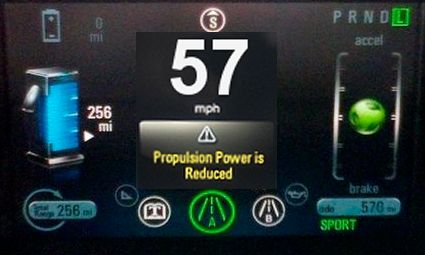
On the way home I thought the road was downhill almost all the way, so I didn’t bother with Mountain Mode. This worked fine until we passed Camp Verde and started up that long climb towards the Prescott turn-off. About half-way up the hill the Volt flashed me a warning “Propulsion power is reduced!”, and we began to slow down — the engine couldn’t keep up, and the battery didn’t have any extra power to donate. I was doing 70 up the hill until then, but I watched my speed slowly drift down — 69… 65… 63… until we finally bottomed out at about 57, where the engine could finally just keep up. Once we crested the hill, we were able to once again accelerate to full speed and had no further problems.

Propulsion

(Simulated display)

I have completely blown my lifetime MPG with this trip, but that’s OK. A car is to be driven and it was a fun experiment to see how the Volt performs under challenging circumstances. With the one difference that you have to manage Mountain Mode, it ran just like any other car up the hill with power to spare.

I averaged 38 MPG for the trip — about 26 MPG going up and over 50 MPG coming down. Not bad. And I finally had to figure out how to open and fill the gas tank for the first time yesterday. After about 2500 miles, I have now burned about 16 gallons of gas.

Eclipse!

Filed under: Computers, Tech & Science,Family Updates — Daryl @ 3:53 pm

Yesterday Derek and I drove up to northern Arizona to view the eclipse. We drove the Volt, but that’s another post.

This was an “annular” eclipse, meaning that the Moon was a little too small to completely block out the Sun as in a total eclipse. Seeing a total eclipse is on my bucket list, but this was still the best eclipse I have seen.

We could have seen the eclipse in Tempe too, but it would have just been a crescent. By driving north we were able to see a full ring, with the Moon completely within the disk of the Sun.

Here’s where we went:

Map

The blue lines indicate the region where the Moon would be seen completely within the disk of the Sun. The red line indicates the line of maximum duration, where the Moon would be centered inside the sun. We were close enough to that middle that it didn’t make much difference visually.

We didn’t have very good optical equipment: A pinhole projector, and camera phones. I tried to buy welding lenses Sunday morning, but of course every Home Depot and Harbor Freight in the state was sold out. Next time I’ll go shopping early! We did meet some other people in the later stages who had eclipse glasses, and it was very cool seeing it directly rather than projected, but I was still unable to take pictures through the glasses.

Here’s what it looked like with the moon about half way in (there are multiple holes of various sizes in our pinhole projector, producing multiple images of varying brightness and clarity):

Crescent

And here’s at the maximum coverage:

Ring

At this time it was noticeably darker and cooler. A half hour before, the sun shining on our bodies was hot and I was wearing sunglasses. At maximum coverage I had to take my sunglasses off, and I could barely feel any heat from sun.

We also had a lot of fun with shadows. The following picture was taken when the sun looked like a ring. Derek and I were standing on a hill casting our shadow on the hill below us. Look carefully in the middle and you can see at least two rings of light in the middle of the shadow. Basically, the gaps between our limbs were acting like pinhole projectors, and creating an image of the sun in the middle of the shadow. Notice too the weird shapes the shadows create, and how the edges are extremely blurred.

Ring Shadow

We noticed another effect as the sun was reduced to a narrow crescent. Normally a shadow is blurry on all edges the same amount because the sun is a circle in the sky and the symmetry blurs the same in all directions. But when the sun is narrow in one direction and long in another, the shadows become asymmetric.

Look at Derek’s arms in the following two pictures. When his arms are extended upper left to lower right, the shadow is fairly distinct, but when they extend from the upper right to lower left the shadow becomes much blurrier (the big rectangle in his right hand is a piece of cardboard).

Shadow Upper Left

Shadow Upper Right

You can also see several crescents throughout the images. Again, projected images of the sun. Notice that the line of the crescents is parallel to Derek’s arms at maximum clarity.

The trip was well worth it for me. I’ve seen 4 or 5 eclipses before, and this one is by far the best so far — it’s the first one where I was positioned to see the moon fully inside the disk of the sun.

But now I want more! People say that on a scale of 1 to 10, a crescent eclipse is a 5, and an annular eclipse is a 9. A total eclipse is a thousand. It is said to be almost religious in its effect on the viewer as waves of shadow sweep across the land, the stars come out and the sun’s corona becomes visible.

There will be a total eclipse sweeping across the central US in August, 2017. I hope to see you there.
May 10, 2012

Prime Time Any Time

Filed under: Computers, Tech & Science,Family Updates — Daryl @ 10:16 am

Dish network just released a new DVR (the Hopper), which I upgraded to yesterday.

There are two improvements that stand out for me.

1) I can get HD on my remote TV. Before, the remote TV just received an SD signal, so this is a big improvement up in our bedroom.

2) Prime Time Any Time. The system records all the Prime Time shows on ABC, CBS, NBC and Fox from 7 – 10 each evening (Arizona Prime Time), and saves them for 8 days. During that time it still leaves 2 tuners free, so I can record up to 6 programs at the same time during Prime Time. This is a big deal, as I was always juggling programs around and having to decide which shows to record and which to skip during prime time. I’ll probably also sample some new programs that I haven’t bothered to record before, since they’ll all be there ready to view any time.

Other incremental improvements include faster interface, 2 TB of storage, and multiple USB ports, but 1 and 2 above are the biggies for me.

May 6, 2012

Saved $360 this month

Filed under: Computers, Tech & Science,Family Updates — Daryl @ 4:25 pm

At the rist of completely boring everyone with more talk of my Volt, here’s a cost comparison I have worked out with my previous car (Acura MDX) and the prototypical gas miser, the Toyota Prius.

Comparing the cost to drive my Volt (at 2.5 cents/mile) and the MDX (25 cents/mile), I have saved $360 this month driving 1600 miles. At this rate, I would save $4320 in a year. Compared to a Prius, at about 45 MPG on regular at about $3.75, I have saved about $93 for the month.

But I’ve been driving 40 miles to see Mom in the hospital almost every day. Past history shows I actually drive on average about 1000 miles/month. In addition, summer electric rates are higher, increasing my costs in the Volt to about 3.9 cents/mile. Averaged over a year, it comes to about 3.3 cents/mile.

Here are tables showing the savings this month, and then in a typical month.

 Price of Energy   Miles/Month   Cost/Month   Cost/Year 
Volt $.025/mile 1600 $40 $480
MDX $4.00/Gal 1600 $400 $4,800
Prius $3.75/Gal 1600 $133 $1,600


 Price of Energy   Miles/Month   Cost/Month   Cost/Year 
Volt $.033/mile 1000 $32 $390
MDX $4.00/Gal 1000 $250 $3,000
Prius $3.75/Gal 1000 $83 $1,000


May 1, 2012

Devon’s latest commercial

Filed under: Family Updates — Daryl @ 3:52 pm

Devon has a very brief, but central, part in this new Ford Fiesta ad.

The girls says, “Oh, a new car!”
Devon replies, “Look at this: ‘CD Player’ “.
They dubbed his voice, as they did the girl.

The idea is that when he gives the voice command “CD Player”, it’s so cool that it’s like a parade or circus suddenly appears.

He had to travel several hours on a bus, work all day, then travel back on a bus overnight just for those couple of seconds.

April 21, 2012

1000 miles

Filed under: Computers, Tech & Science,Family Updates — Daryl @ 4:05 pm

I just passed 1000 miles in my new Volt (1024 to be precise). I am still on my first tank of gas — I’ve used about 6 gallons so far, leaving a little more than 3 in the tank. 807 miles were all electric, and the remaining 217 were using gas — most of them driving out to Wickenburg to see Richard and Dianna a couple of weeks ago.

I am still in love with this car!

April 8, 2012

Burning Gas

Filed under: Computers, Tech & Science,Family Updates — Daryl @ 5:57 pm

I took a trip out to see Richard and Dianna today in my Volt. They are staying near the village of Congress, about 90 miles from my house. I was interested to see how the Volt did on a longer trip. Here are some numbers:

First a summary:
— It cost the same to make the trip as if I was driving a pure gas car that got 52 miles/gallon, figuring the cost of electricity and gas.
— I drove 53 miles on battery alone, and 127 on 3.27 gallons of gas.
— Pure gas mileage was 39 miles/gallon
— Altogether, since buying the car I have driven 512 miles on 3.7 gallons of gas, leaving my tank still over half full.
— We ate a very good (and spicy!) homemade tomato soup and Mexican cornbread for lunch. Thanks Dianna!

Some Details:
I made it about 38 miles from home before I ran out of battery and the car (automatically) switched over to gas. After charging at Richards, I added about 15 more miles coming home, so for the 180 mile round trip I did about 53 of them on electricity alone. The remaining 127 were done on 3.27 gallons of gas, for a pure gas mileage of 39 miles/gallon.

The pseudo mileage (total distance/total gas) was 55 miles/gallon, but that is calling the electric miles free, which isn’t quite accurate. To make it a little more complicated, since electricity costs about 1/4 of gas for equivalent miles driven, the cost of driving on electricity is the same as the cost of gas at 155 miles/gallon. So 155 miles/gallon for 53 miles, and 39 miles/gallon for 127 miles gives an equivalent to 52 miles/gallon. In other words, if I had a car that got 52 miles/gallon, it would have cost me the same to make the trip as it did in the Volt. It’s about how well a Prius would do.

For shorter trips, especially where I never use gas, the cost is the same as a car that gets 155 miles/gallon. As trips get longer, the cost approaches that of a car getting 39 miles/gallon. So if you frequently drive long distances and your main goal is to save on fuel, get a Prius. If most of your driving is around town and you usually drive less than about 40 miles in a day, a Volt will be cheaper to operate (though not cheaper to buy). Having driven both I have to say that a Volt is more fun to drive.

March 30, 2012

Volt

Filed under: Computers, Tech & Science,Family Updates — Daryl @ 9:39 am

After buying my Acura MDX a year and a half ago, I had buyer’s remorse. One comment I made below this post was that I could have bought a Chevy Volt instead, since it looked like I was going to keep my Honda mini-van anyway. Well, I finally did just that. I traded in my Acura for an electric car.

I’ve been following the Volt since it was just a concept car at Chevy, several years ago. It caught my imagination right from the start: A plug-in electric car that had a back-up generator on board that would power the car if the batteries were exhausted. This solves the main kick against electric cars — range anxiety.

There are a few things I’m going to miss from my Acura. It was a very nice car. I will miss:

-Adaptive Cruise Control (I used this all the time, even around town)
-Blind spot detection (I also depended on this a lot)
-5 Adult + 2 Children carrying capacity (But I have my van if I need to carry more people)
-Rear seat air conditioning
-All Wheel Drive (never used after the first six months)
-Crash Mitigation Braking System (which I’m glad I never had to use!)

But here’s what I get with the Volt:
– Cost per mile around 2.5 cents, vs 25 cents in the Acura
– Acceleration (The Volt is the fastest car I have owned from zero to 45)
– Maintenance schedule:
   + Every 7500 miles rotate the tires
   + Every two years change the oil
   + Every 55,000 miles change the engine air filter
   That’s it! Even the brake pads don’t wear, since braking is mostly regenerative.
-Keyless entry and start
-Remote “start” (starts the climate control)
-Smart phone “start”, and charge monitoring
-OnStar
-Designed and built in America
-Just plain cool

According to Consumer Reports, the Volt has the highest owner satisfaction level of any car on the market, with the Porsche 911 running second.

I’ll post some pictures when I get a chance.

March 23, 2012

$2.58

Filed under: Computers, Tech & Science,Family Updates — Daryl @ 10:55 am

That’s how much electricity I bought from SRP this month. There is a $15 service charge each month and some taxes added on that, so my total bill is $19.21. Last March I paid $116. I would have been net negative this month except for a couple of cloudy days.

As I’ve mentioned before, March and April are the best months for solar power, since the days are getting longer but the temperatures are mild so there isn’t much (any) need for heating or cooling. I’m sure my July and August bills will be substantial.

So far the system is exceeding the estimates of the company that installed it.

« Newer Posts — Older Posts »

Powered by WordPress