News and Views From my kids accomplishments, to my heretical perspective of the world

September 7, 2015

Cloudy, rainy day

Filed under: Family Updates — Daryl @ 10:06 am

Staying another night in the Ocean View park near Leading Tickles, although the weather has turned chilly, cloudy and rainy. The camp hostess thought we would leave with everyone else because of the weather, but we told her it will be raining anywhere we go, so we might as well stay where it’s so beautiful.

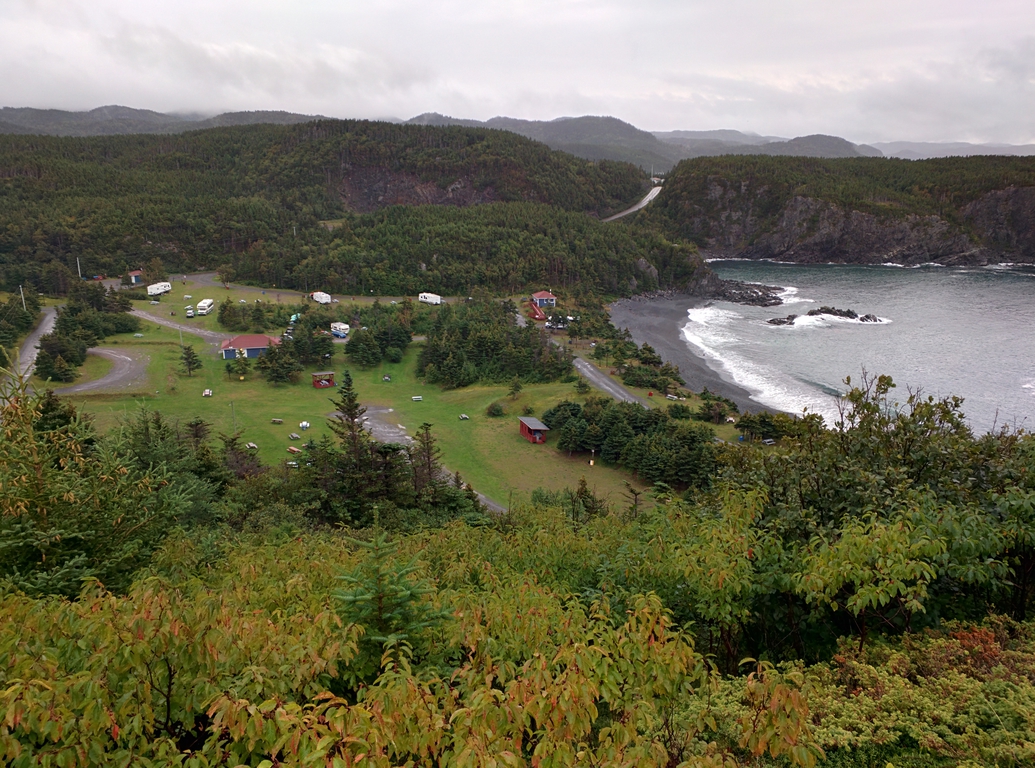
HighView

I hiked up to the top of the hill and took this picture of the park. You can just make out the white of our RV through the trees next to the beach. It’s right in front of the red building.

There’s another very similar beach just outside the picture on the left. The park is on a peninsula.

We went over to the snack bar where the lady was preparing to shut down for the season. She gave us a free ice cream cone.

September 6, 2015

Leading Tickles

Filed under: Family Updates — Daryl @ 5:34 pm

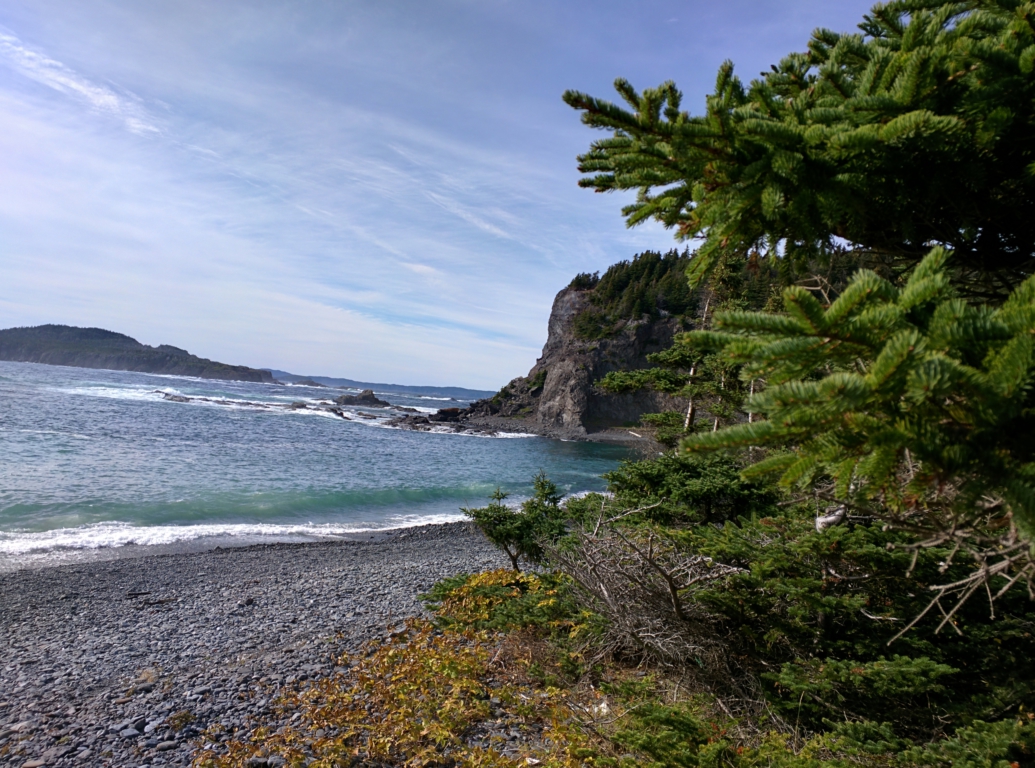
We are spending our third night near the village of Leading Tickles, on the north coast of Newfoundland. Our campsite is less than 100 feet from the ocean surf, which should lull us to sleep tonight. It’s the nicest of the three places we have stayed. (A Tickle is Newfoundlandese for a small, narrow strait, we found out.)

Beach Camp Site

On the first night we just pulled off the road near “Came-by-Chance” by a historical sign and dry camped; no water, electricity or sewer hookup. But our RV is self-contained so it was no problem. The second night we stayed in a very nice RV park in Grand Falls-Windsor, with plenty of trees and lots of room between campsites and with full hookups. But tonight by the sea is the nicest by far, and we will probably stay another night.

We didn’t realize when we planned this trip that Canada celebrates Labour Day the same day that we do, so many of the RV parks we called were booked full. We have been lucky to find the ones we did. After tonight it should become much easier as people go home and back to work. On the other hand, the hostess of this park told us that she is closing for the year after tomorrow, so there may be fewer options.

On the first day in St. John’s we stood on the hill where Marconi received the first trans-Atlantic radio transmission. Trans-Atlantic meaning from the island of Ireland to the island of Newfoundland; kind of cheating but still a big accomplishment. (Would Iceland to Greenland also have qualified as trans-Atlantic?) It was believed impossible at the time because of the curvature of the earth; they didn’t think the radio waves could bend around the corner. That was before the discovery of the ionosphere which acts to bend or reflect radio waves and allow them to travel long distances over the horizon.

We are slowly making our way towards a ferry boat reservation on the 11th that will take us to Nova Scotia, but first have two nights reserved on the 9th and 10th in Gros Morne National Park, reportedly the nicest park in the province.

We found a little bit of an explanation for the half-hour offset of clocks on the island. They are located in what would be the far eastern edge of the time zone and many years ago decided to shift by a half hour. In the 1960’s there was a ballot proposition to shift back to the hour, in sync with the rest of the world, but it was strongly defeated. I think part of it is that they enjoy being different and special. Otherwise, a half hour doesn’t really make that much difference.

July 17, 2015

Satellite Phone

Filed under: Computers, Tech & Science,Family Updates — Daryl @ 2:42 pm

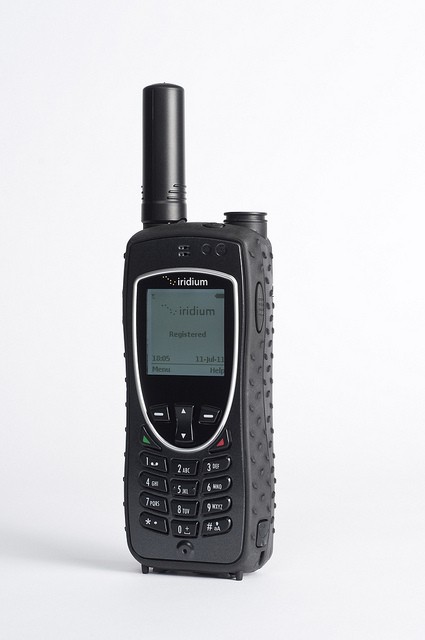
We bought a satellite phone.

Extreme

We do a lot of world travel, and I do some hiking and 4-wheeling into areas with no phone service, so it should be useful, even just for emergencies and peace of mind. I was on a backpacking trip a couple of years ago in the Sierra when a passing hiker’s satellite phone saved one of our party from a desperate situation. I was out 4-wheeling when the car broke down and it was just by luck that another 4-wheeler came by and helped us out.

There are several satellite phone networks, some in geosynchronous orbit and some in low earth orbits. Each has advantages and disadvantages. Geosynchronous satellites are always in the same spot in the sky and if you are at a lower latitude you should always be able to connect to one (assuming you have line of sight with no trees or canyons around) Once connected the signal won’t fade or be lost. However, the distance the signal has to travel introduces lag and if you are above about 70 degrees latitude (north or south) you cannot connect.

Low earth orbit satellites consist of whole swarms of satellites, each in its own orbit circling the earth.

The low earth orbit option I chose is Iridium. Iridium’s swarm of 66 satellites 485 miles up in polar orbits has a satellite in reach of every point on the earth “almost all of the time”. Coincidentally, Iridium’s gateway is in Tempe about a mile from my house, but that doesn’t give me any advantages.

It costs a lot of money to put all those satellites in orbit (billions of dollars) and to maintain the network. Iridium went bankrupt in 1999, about a year after they went into service, part of the problem being that until all the satellites were up they couldn’t offer reliable communication. Phones were large, heavy and expensive, as were connections, and the market was not there.

They were bought out by another company a couple of years later for a fraction of the investment and have become commercially successful. According to the Wikipedia article linked to above, the US Department of Defense makes up about 1/4 of Iridium’s revenue.

There actually are a few places in the world where even an Iridium phone won’t connect, but it’s for political rather than technical reasons. A few countries don’t allow them (Cuba, North Korea…), so if you are detected to be in one of those countries the phone refuses to connect.

Satellite phones are really not much more expensive than cell phones, but the provider doesn’t subsidize the phones like ATT, Verizon and T-Mobile do. If you want a phone, you pay full price. Monthly contracts are not too expensive either compared to cell phone plans, but they generally don’t include many minutes and extra minutes are expensive. For example, my plan is $50/month and includes 10 minutes. Extra minutes are $1.29 each. That could add up pretty quickly. On the plus side, I can receive text messages (of 160 characters or less) for free, though sending one costs $.75 each.

Obviously at those prices it’s not for casual chatting or long soul-searching conversations. It’s an emergency device, and a quick update device.

I bought the smallest, lightest Iridium phone I could find: the Iridium Extreme. It is tougher than most — Mil spec ruggedized — so it should survive backpacking drops and falls, and is lighter than most at under 9 ounces, barely an ounce heavier than my cell phone. I tried it out in the back yard; it connected very quickly and surprisingly even retained the connection after coming back into my kitchen.

April 3, 2015

Washington DC

Filed under: Family Updates — Daryl @ 7:40 pm

Not much to say about a city that everyone except Gisele and I have been to before. White House, Capitol, Smithsonian, Memorials, …

We chose this time to come so we could see the cherry blossoms, and there are quite a few around, but otherwise it’s a bad time. Lots of other people also want to see the cherry blossoms, and lots of kids are on spring break. It took us about a half hour to get into the Air and Space museum today, and it was wall to wall people. Still worth the visit, of course.

Our hotel is kind of interesting, I guess. It’s on the “National Trust for Historic Preservation” list of “Historic Hotels of America”, one of 260. Built in 1929, it’s hardly ancient, but it is quaint and is clean and neat. It’s on Pennsylvania Avenue, about a 10 minute walk from the White House, so it’s in a convenient location.

We did a lot of walking on the first day, but have since got smart and have used the Metro a lot more. There is a station about 5 minutes from our hotel.

Dale wanted me to talk about weird people, but unfortunately we haven’t met any. I’ll keep my eye open for one, just for you Dale.

Maybe Library of Congress tomorrow…?

January 16, 2015

Another Broken Bone

Filed under: Family Updates — Daryl @ 10:57 am

Playing basketball (of course) Wednesday morning, when I reached in to steal a pass. Instead, the ball impacted the tip of my pinkie which immediately started bleeding. It didn’t hurt much, so I wrapped it up and kept playing.

That day was OK, though it hurt a little to type with that finger. I assumed it was just another jammed finger, of which I have had plenty.

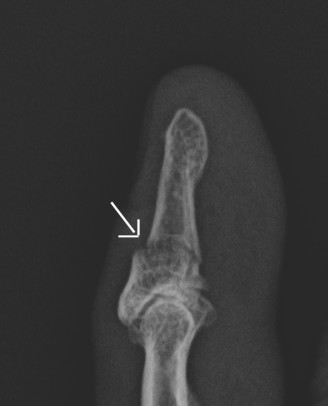
The next day the whole hand started swelling and hurting. It got so bad that I had to take oxycodone in order to sleep last night. So this morning I went to an Urgent Care center and had x-rays taken.

Finger x-ray

They splinted it, prescribed pain and antibiotic medication, and said I should see an orthopedic surgeon. Not sure if I will bother. Nothing to do but wait till it heals, 3-4 weeks.

Update: I made an appointment with a hand surgeon for Monday. Dr Haber is the hand surgeon for ASU and the Phoenix Suns, so I should be in good hands…

January 9, 2015

Cutting the Cheese Mold

Filed under: Family Updates — Daryl @ 9:13 am

There was a cheese factory in Cuba, NY, the town I was born in. I grew up eating this cheese in everything from toasted cheese sandwiches to macaroni and cheese. It is unique and delicious.

Living in Arizona I don’t get much opportunity to eat Cuba cheese any more, but I recently came into acquisition of two and a half pounds of the precious substance.

The problem is that the Cuba Cheese Factory doesn’t use mold inhibitors in their products, and it shows. The cheese will start showing mold in a week or two, and there’s no way I can eat 2.5 pounds of cheese that quickly. Once I cut into the wrapper the clock starts ticking and the mold starts growing.

One solution we have tried in the past is freezing. This does stop the mold, but it renders the cheese crumbly and seems to modify the taste a little. It’s better than mold, but not ideal.

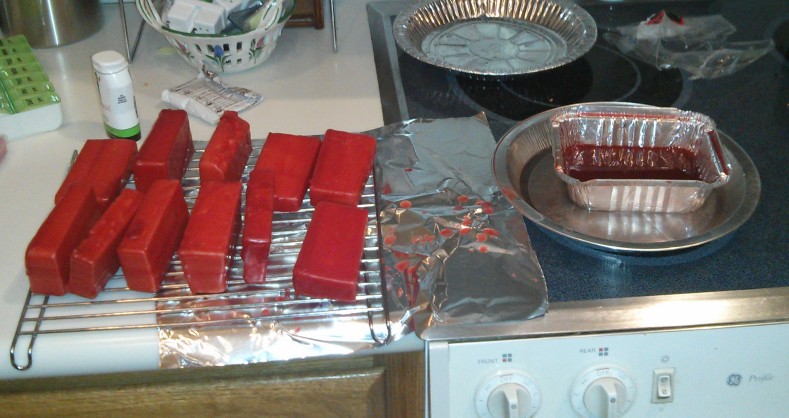
This time we’re trying something new: Wax. I bought some cheese wax, cut the big loaf into quarter-pound pieces and dipped each piece into the melted wax. The heat of the wax is supposed to kill any mold that may have started. I’ll store these pieces in the refrigerator and only cut into each piece as we finish the last one.

It’s the first time I’ve tried this so I can’t be sure how well it will work. Maybe enough spores survived the dipping and when I remove the wax I’ll find huge mold growths. I’ll find out in a few weeks.

Waxing cheese

January 7, 2015

Rocky Point

Filed under: Family Updates — Daryl @ 3:01 pm

When I was in my teens our family spent several vacations at Rocky Point in Mexico. It was a sleepy little Mexican village, and we camped on the beach, either in a trailer that we hauled down there, or in tents, or just on a tarp on the sand. We spent several idyllic weekends there in my youth.

Last week my family went down to Rocky Point again and spent 3 nights. What a difference! There are huge luxury condos up and down the beach. The town doesn’t seem much different, with many dirt roads, but it is certainly larger. We stayed on Sandy Beach, while in my teens we camped at Shell Beach. We didn’t get a chance to visit Shell Beach, so I don’t know how much it has changed there.

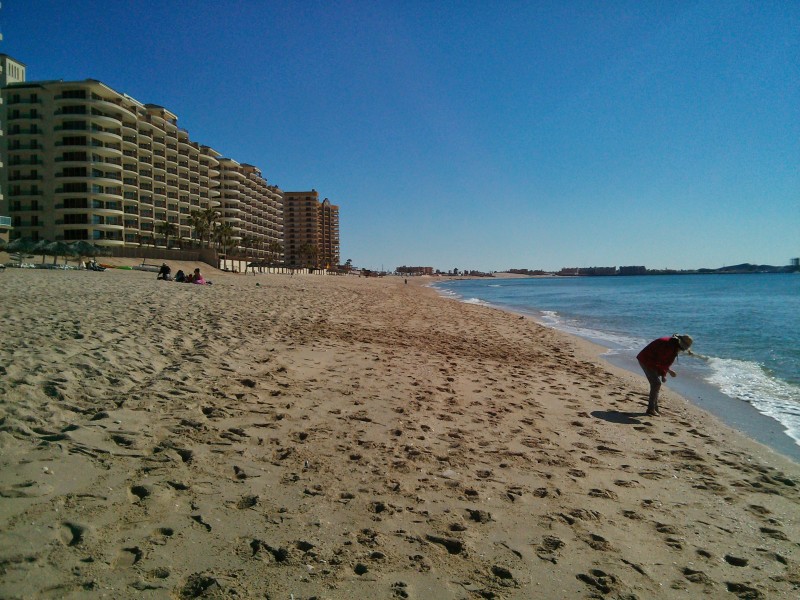
Beach
Right in front of our resort. It looks the same in the other direction. That’s Gisele looking at sea shells.

The heat wasn’t working in the first condo we took (a 3 bedroom/2 bath — about 1600 sq ft) and it was freezing cold. They tried to find us another one that night, but the heat wasn’t working in the other ones they tried, so we were stuck. I turned the electric oven on and opened the oven door, put on extra blankets and we slept OK.

The next day they moved us to a nicer condo (3 bedroom/3 bath — about 2000 sq ft) and instead of charging us more they gave us back part of the rent for the first night, so for two nights we got to sleep in a very nice condo on the 7th floor with nice views of the beach.

We chose a particularly cold time to visit the beach, with night time temperatures around freezing, days mid-50s and windy. The boys and I soaked a little in a hot tub, but it wasn’t the optimal time for a visit to Rocky Point. On the other hand, the crowds were very thin

I unfortunately brought something home with me, with the resulting diarrhea, head ache, chills and fever (101.1). I don’t feel bad-bad, just not very good.

December 10, 2014

Orlando

Filed under: Family Updates — Daryl @ 7:25 pm

After the iDigBio conference (“Hackathon”) in Gainesville, we came to Orlando to play.

3 1/2 days at Disney World were lots of fun. Big crowds Saturday evening at the Magic Kingdom, and pretty big crowds Sunday at Epcot, but by Monday at Animal Kingdom and Tuesday at Hollywood Studios, we pretty much just walked on to any ride or entertainment without waiting. We still had to weave through the winding queue lanes, but they were empty almost all the way to the rides.

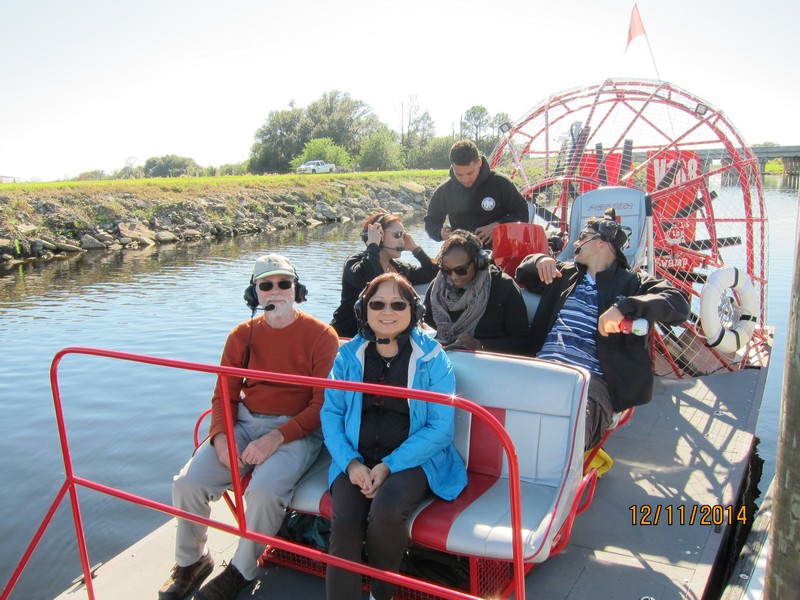
Today we went out on an air boat into the Everglades, or a portion of the Everglades near Orlando. It was lots of fun zooming over the water and lily pads and through the reeds; those air boats can go almost anywhere there is water.

Air Boat
Ready to go! The head sets served to muffle the sound of the engine, and allowed us to all talk and hear the guide.

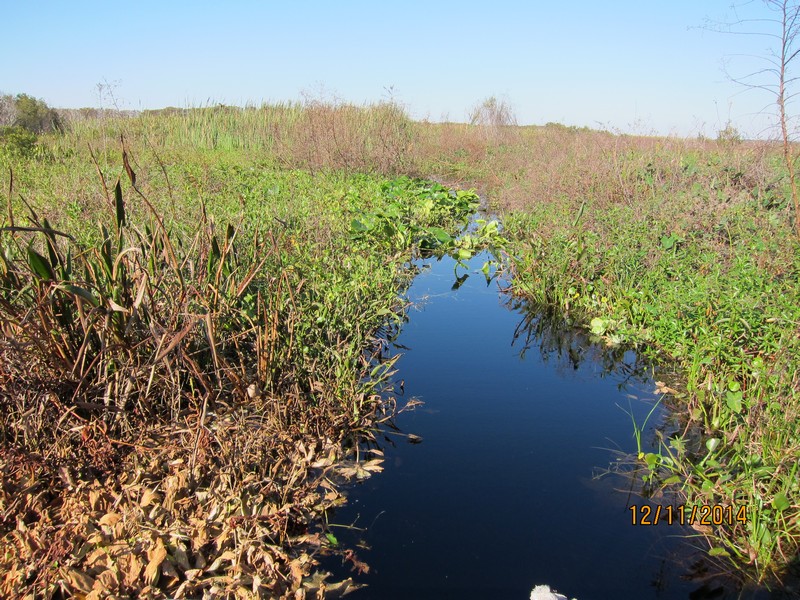
Swamp
No way through here except with an air boat. We went.

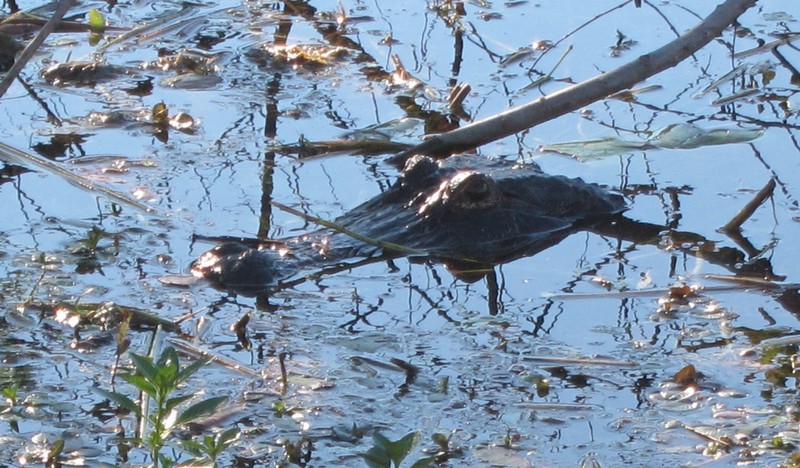
We saw several alligators, a couple of them approaching 10 feet long, and almost ran over a group of one-foot babies that quickly swam out of the way.

Gator
This was a big one — approaching 10 feet long. He was about 20 feet from the boat. We saw others out of the water, but not quite this close.

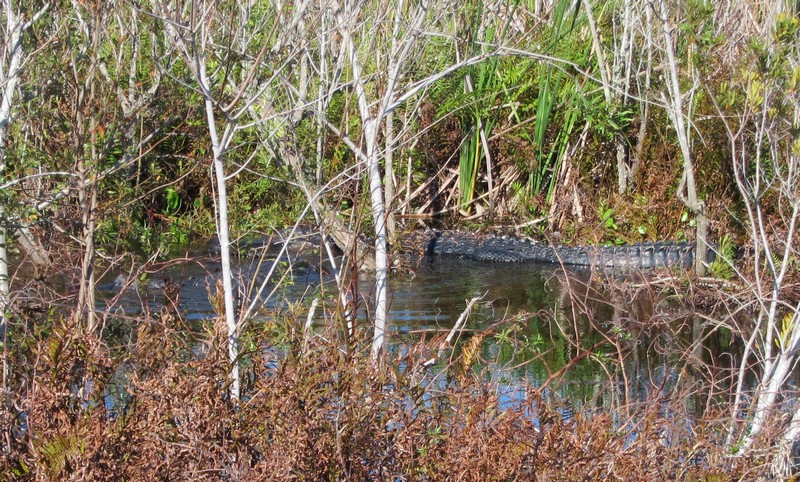
Gators
There are two alligators in this picture, though hard to see the second. The one you can see stretched across the middle was 8 or 9 feet long. His head is on the left — you can just make out his nose sticking past the small tree trunk.

There was lots of other wildlife, including a water moccasin (no picture), a few turtles and lots of birds.

Cormorant
I think this was a cormorant. We saw lots more, along with blue herons, ducks, egrets, and more.

Tomorrow we are planning to go to Kennedy Space Center in the morning and afternoon, then to see a showing of Cirque du Soleil in Downtown Disney in the evening. Friday we go back home.

December 5, 2014

iDigBio

Filed under: Computers, Tech & Science,Family Updates — Daryl @ 7:32 pm

It’s pronounced “I Dig Bio”, and that’s what I’ve been working on for the past three days. I’ve been in Gainesville at the University of Florida which is sponsoring a “Hackathon” for iDigBio.

iDigBio is a collaboration (funded by the National Science Foundation) between universities and museums all over the world with a focus on digitizing natural science collections, hence the name “Integrated Digitized Biocollections”. This particular hackathon had about 25 attendees mostly from the US, but Australia and Scotland were also represented. We met to discuss and develop programs and processes to help simplify and automate the digitization process.

Filed away in basements and cabinets all over the world are hundreds of millions or billions of plant, animal, insect, mineral and other specimens collected over the past few centuries. Up to now, these specimens were only available to a few researchers and even then one had to either travel to the specimen or ship the specimen to the researcher. This current effort is to upload to the internet pictures and details about each of the specimens to make them available not only to researchers but also to the general public. It is a big effort and without some automation almost impossible. Another approach to the problem is “crowd sourcing” — using volunteer “citizen scientists” to help, and that was also a major topic of this meeting. An example of a crowd sourced project is “Notes From Nature” where volunteers have just passed one million transcriptions.

My involvement and invitation came about because of programs I developed at Arizona State University to help automate the digitization of their plant specimens. Nearly one hundred thousand records passed through my program, SALIX, and I am now working on a web version of this program that can (hopefully!) be used by institutions all over the country and world.

It’s been an interesting and fun three days working with experts in the field. I’ve learned a lot and, I hope, contributed to the effort. There’s still a lot to do!

Tomorrow Gisele and I leave Gainesville and drive to Orlando where we’ll spend a few days at Walt Disney World.

November 13, 2014

Post Retirement Career

Filed under: Family Updates — Daryl @ 9:41 am

When I retired from Intel 14 years ago I didn’t have any plans other than not doing what I was tired of doing. I had no idea of the opportunities that would open up for me.

Here’s a brief update on my “career” since then.

Arizona Neighborhoods
For several years, I helped my friend Don Bates develop a set of thousands of websites, each focused on one subdivision in the Phoenix area (AZNB.COM). That was fun and challenging, and I still help out with a little maintenance from time to time, but there haven’t been any major developments for a few years.

ASU
Soon after I retired I met the husband of one of Gisele’s friends. Les is a professor of plant biology at ASU (Arizona State University). I should say “was” since he just retired last month. Les and I both shared interest in hiking, which soon developed into a friendship and subsequently into a research partnership, with my part being mostly programming. Les and I have worked together on several projects, some of which led to published papers. For example:

PlantMap
— I wrote a program that queried the database of plants to plot locations where specific species were found on a map of Arizona. I later found that other teachers at ASU were using this program in their classes as an assignment. (Derek’s girlfriend, Stephanie, came to dinner one night telling how her biology professor gave the class an assignment to go to “daryllafferty.com…”. She was quite surprised, to say the least!)

Germination
— We developed another program that simulated plants growing in a desert environment. You could vary attributes such as how much water it needed, how quickly a seed would germinate after getting wet, how heat affected it, etc.. We presented this at a couple of biology conferences.

Proximity Correlation
— We recently created a program that would query the database of plants to find those that often grow together, in an attempt to describe “biomes” — typical environments such as Pine Forest, Chaparral, Riparian, etc. These biomes have been described before but just based on observation and intuition. Ours is the first attempt we are aware of that tries to quantify these ecosystems. One interesting feature is that if you have an animal or insect with location information you can add it to the list and determine which plants the animals were most likely to be associated with. We have just submitted a paper describing the project for publication in a major international journal, (TAXON).

SALIX
— One of my biggest projects was called “SALIX” (Latin for willow). Les is (was) the curator of the ASU Herbarium. A herbarium is like a museum or library where hundreds of thousands of plant specimens are collected and stored, each flattened and glued to a large sheet of heavy paper. On each sheet is a label indicating data such as the scientific name, who collected it, when and where it was collected (descriptively and often including latitude, longitude and elevation), other plants in the vicinity, and several other bits of information. There are no standards on how the information is arranged or labeled.

There is a big push in the scientific collections world to database this type of information and make it generally available for research. SALIX is a program that can read the label and identify the information, determining which is the collector’s name, when and where it was collected, etc. The program was used extensively at ASU for adding their specimens to the database. The alternative to a program such as SALIX is manually reading and typing the information into a form, which is slower and more prone to errors (typos) and abbreviated information.

Recently another major herbarium has provided us funding to create a web version of the program so that it can be used anywhere by anyone. I am deep into that project now, and hope to have a usable version by early next year.

Next month I’m flying to Florida State University (Gainesville) to participate in a working group developing methods to improve the databasing of scientific collections.

So if you’ve read this far you have a small idea of what I’ve been doing for the past 14 years. It’s been more fun than I ever imagined!
Older Posts »

Powered by WordPress