News and Views From my kids accomplishments, to my heretical perspective of the world

June 30, 2013

We’re (not) Number One! We’re (not) Number One!

Filed under: Opinion — Daryl @ 11:44 am

I recently read a very interesting book, “The Measure of a Nation“. The author compared the United States to thirteen other large, developed democracies (Australia, Belgium, Canada, France, Germany, Greece, Italy, Japan, Portugal, Netherlands, Korea, Spain, and the UK) on several factors, including health, wealth, crime, education, equality, freedom and democracy.

There is a general opinion in the US that we are the best in the world in almost every way. It’s certainly true that we have the largest economy and the strongest military, but an objective evaluation shows that we lag behind in other measures.

Health
I often hear that “America has the best healthcare system in the world”. However, US life expectancy is the lowest in the group, infant mortality is the highest, maternal mortality is the highest, and cost per person is roughly double any of the other countries. If we were a corporation the shareholders would complain that the highest cost for the worst results is hardly the “best in the world”. And medical costs here are much more likely to lead to bankruptcy than in the other countries primarily because of lack of adequate insurance.

Crime
The US homicide rate is more than twice any of the other countries. The incarceration rate is more than 4 times any other.

Education
The US ranks 10th on standardized test scores of reading, math and science, beating only Portugal, Italy, Spain and Greece. This compares with the mid-20th century when the US was known for having the best educated workforce.

Wealth and Equality
We like to think of the US as the “land of opportunity”, where anyone can make it if they only work hard enough, that America is a meritocracy. But by several measures the US is very unequal. One measure of income equality, the “Gini Index,” being a rough measure of the ratio between those at the top 10% earning level and those at the bottom 10%, puts the US in 13th place among the 14 countries. And this ratio has been getting worse over the past 2-3 decades.

One could argue that this is only fair — the people at the top have worked hardest and deserve to earn more than the laggards at the bottom. Is the US a “land of opportunity”? One way to measure is to compare a father’s income with his son’s income. If poor fathers have poor sons, that indicates little upward mobility. If there is little correlation between a father’s wealth and son’s wealth, that indicates more socioeconomic mobility. By this measure, the US has far less mobility than any of the other countries. Children of poor parents remain poor. Children of rich parents remain rich. In Canada, for example, a poor son was twice as likely to rise to a higher income level than his father, compared to the US.

Democracy
By some measures the United States invented democracy. Other countries such as ancient Greece approached it, but the US was a real breakthrough that has been emulated by many other countries around the world, including the other countries in the study. The genius of separation of powers, checks and balances, and the Bill of Rights, have remained relatively unchanged over more than two centuries. Despite its brilliance, there have been blemishes over the years, such as slavery, internment camps, election fiascoes and racial inequality. So while other countries emulated us, none of them adopted wholesale our original model, but rather changed it where they thought it could be improved, in particular with the way elections are held, and especially the antiquated Electoral College.

The US model makes it almost impossible for third party candidates to be elected, and in fact voting for Green, Tea, or Libertarian parties is seen as “throwing your vote away”. Some countries use runoff elections, where if no candidate gets a majority of the votes another election is held with only the candidates getting the most votes. Australia has an “instant runoff” system that to me seems like the best approach. When you cast your ballot you rank your candidates in order of preference. Votes are first tallied on first choices. If there is no majority, then that candidate getting the fewest votes is dropped, and his ballots are reallocated by second preference, etc. until one candidate has a majority. So you can vote for your fringe party without any risk that your vote will enhance an opposition party’s chances.

There are many other measures of democracy and freedom discussed in the book, such as voter turnout, rule of law, government stability, the “voice of the people”, government accountability, gerrymandered districts and regulatory quality, all of which put the US somewhere in the middle of the pack.

Conclusions
The book went into much more detail than I can here, explaining the statistics with charts and tables, and with recommendations for improvement. I urge everyone to read it.

The United States of America is a wonderful place to live and better than 90% of the other countries on the planet. But let’s not keep fooling ourselves that it is the best in every way and that there is no room for improvement. Let’s adopt a little humility, face the problems and learn from other countries.
June 19, 2013

Detached Retina

Filed under: Computers, Tech & Science,Family Updates — Daryl @ 10:30 pm

My mother just had surgery today for a detached retina.

I was at her house on Friday last week when she mentioned to me that she couldn’t see out of one side of her eye. There seemed to be a curtain over it.

That sounded like the classic symptom of a detaching retina, and I immediately called her ophthalmologist. They had her come in immediately. However, the doctor was unable to see any problems or damage to the retina. She referred Mom to a retina specialist, but the earliest they could get her in was the following Wednesday. The doctor seemed confident enough that it wasn’t a detached retina that waiting a few days wouldn’t hurt.

But on Tuesday Mom mentioned that the curtain had grown and was now covering almost half her vision in that eye. I immediately called the retina specialist and they had me bring her right in. This time the specialist could see that the retina was definitely detached. That was the bad news. The good news was that the detachment was in a quadrant that generally progresses slowly and there was no immediate danger of reaching the center of her vision (fovea centralis). So instead of going in that evening, he scheduled it for the following day, today, Wednesday.

So today Dale and I drove her 60 miles from her house to Sun City where the doctor performed surgery and fixed her retina.

The technique (Pneumatic Retinopexy) is interesting. There were two steps. First, he injected some gas into the eyeball. The gas bubble pushes against the retina and forces it back into place in the back of the eye. Then they shoot a laser to “weld” the retina into place. The gas bubble has to remain against the retina while it heals, so it’s important that she maintain her head in a specific orientation to bring that area of the retina up, so the bubble floats up against it. That means sleeping on her left side, which she hasn’t done in many years. She says it hurts her hips. Fortunately (?) she is taking Vicodin for the pain and so her hip shouldn’t bother her much tonight. She needs to continue this way for 7 days. Hopefully her hip will get used to it.

Prognosis is good. The surgeon said that as long as she lets that bubble do its work for a few days she should heal and recover pretty much all her vision, or at least all that macular degeneration has left her.

Now if they could have done that 55 years ago, I might enjoy watching 3D movies today.

June 11, 2013

eGallons

Filed under: Uncategorized — Daryl @ 9:36 am

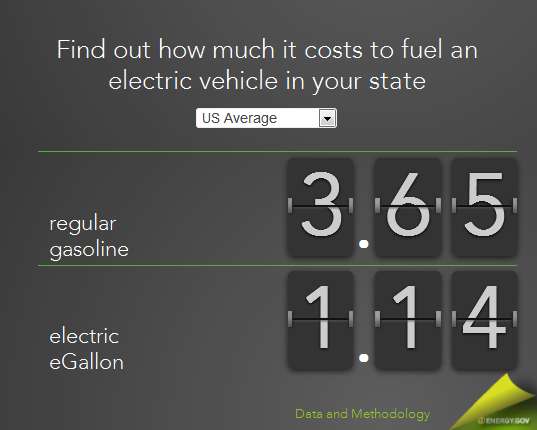
The US Department of Energy has published an app that will calculate how much it costs to fuel an electric car vs. a gas car. They created a concept called an eGallon which shows how much it would cost to drive an electric car the same distance as a similar gas car would go on a gallon of gas. Here’s the average for the US:

eGallon

Click on the image to see the active app and enter your own state.

As they point out in the article, on average it costs about 1/3 as much to drive electric, more in some states, less in others.

June 8, 2013

Back Home

Filed under: Family Updates — Daryl @ 10:41 am

We arrived back in Phoenix last night around 6:00pm. The pilot announced that it was 111 degrees as we were approaching the airport. What a shock after three weeks of temperatures in the 60s!

It was a great trip. We met a lot of friendly and helpful French people, who don’t deserve their reputation of hostility towards Americans. If you approach them respectfully they will reciprocate likewise.

Annecy in the foothills of the Alps was wonderful. Gisele and I are talking about going back there sometime and spending a few weeks, perhaps taking classes at a language institute.

Normandy was very moving, and prompted me to read “The Longest Day”, about the D-Day invasion. There is a lot of history in the area, and plenty of museums to display it.

The excesses of Versaille, the enormous estate built by Louis the 14th, helped me understand what pushed the French people to revolution a few years later. So much opulence while the people were starving in the streets. While there are still great inequities of wealth in the world, democracy tends to reduce the ability of a head of government to grab all the wealth for himself.

With the excepting of having my phone picked from my pocket, the time in Paris was also pleasant. The mass transit system there is among the best in the world. You can generally catch a subway within a 5-minute walk of wherever you are and end up within 5 minutes of where you want to go. Of course, you may walk over 5 minutes within a station going from train to train. My main complaint about Paris is the size of the hotel rooms.

Gisele would probably go back to France every year, but there are too many other places in the world I haven’t seen, or would like to see again, so I don’t expect this to become an annual pilgrimage for me. But I’ll be glad to go again some year, but let me get over jet lag first.

June 3, 2013

Driving in France

Filed under: Uncategorized — Daryl @ 1:10 pm

Driving in France has one big advantage over driving in England,at least for an American: they drive on the right side of the road here.

It’s really not bad driving here, and the French drivers are competent and disciplined. Road signs can be confusing. For example, what would you make of “Interdict sauf” followed by a picture of a bicycle? Watch for bicycles? No bicycles allowed? Actually I learned from Gisele that it means “Prohibited except bicycles”. Little things like that take some learning.

We rented an Opal Astro for our trip to Normandy. Opal is GMs European label, and the controls are very similar to my Chevy Volt. The rental agent told me that 95% of cars in France (and Europe, I assume) are diesel, and roughly the same proportion are manual transmission, most of the new ones 6-speed. Diesel fuel is much cheaper here than gas, and gets better mileage. Diesel costs about $6 per gallon, while gasoline is closer to $8. I am getting almost 40 mpg with my Opal, and the performance is quite good. I’m not sure why diesel costs more than gas in the US, but a better question might be why is gas so cheap.

Of course all the measurements are metric, but once you get used to it, it’s very easy to work with. Quick: How many feet in 1/4 miles? It takes a little thought. The equivalent metric question is easy: 250 meters in 1/4 kilometers.

Anyway, we’re enjoying our little jaunt around the French countryside.

June 2, 2013

Omaha Beach

Filed under: Family Updates — Daryl @ 11:02 am

After the other women returned to the US yesterday, Gisele and I drove to the small town of Bayeux in Normandy. Today we went to Omaha Beach, the first landing point on D-Day, June 6, 1944.

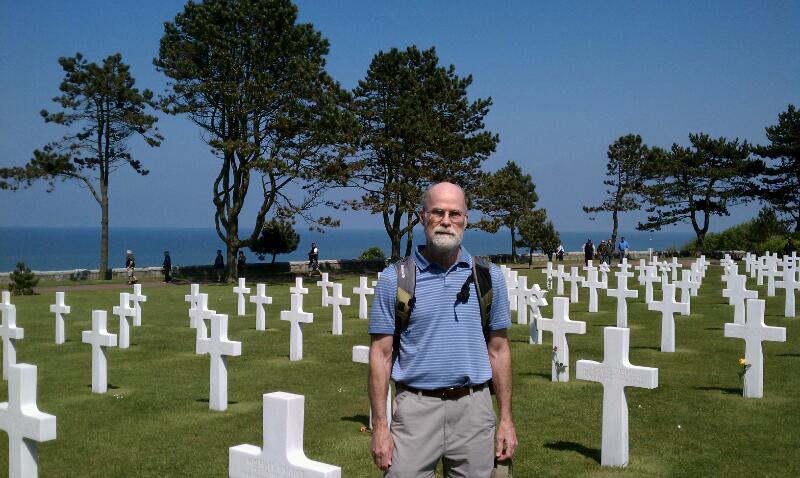
We first went to the American Cemetery near the beach.

cemetery

I didn’t expect to be as moved as I was. As I walked through the field of cross after cross, I began reading the names, rank, state, and date of death on each cross (or star of David). It brought home to me that each one represented a real person who had died here in Normandy. There are so many!

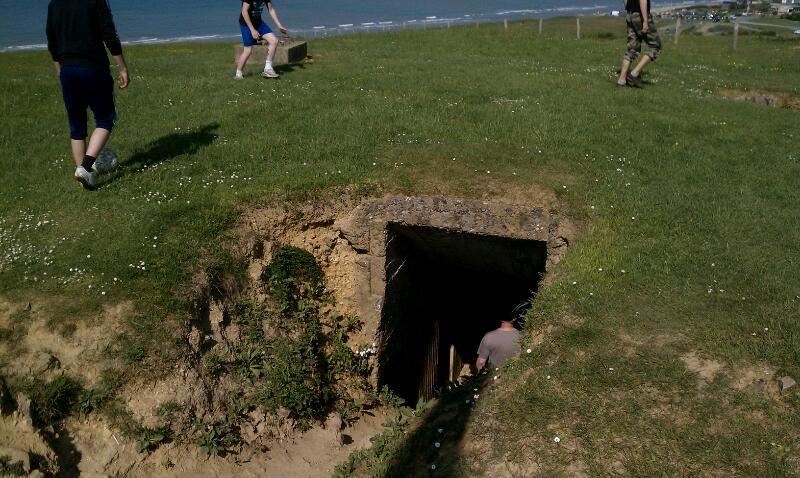
We then went to the hills above the beach and explored the ruins of the German bunkers overlooking the beach.

bunker

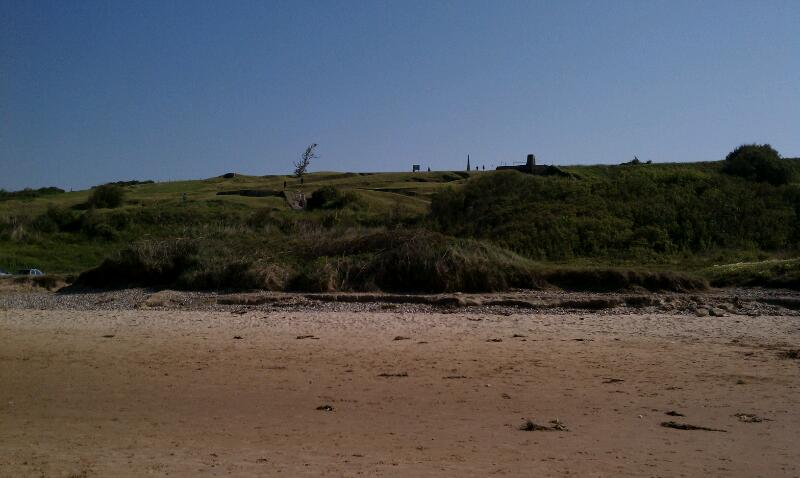
Finally I went down on the beach where the American troops landed and looked up at the hill.
beach

I kept thinking of the D-Day scene from “Saving Private Ryan”. I could see where the German bunkers were located, and I imagined trying to move up that hill carrying 75 pounds of equipment while being fired on from above.

I will definately watch SPR again with a new perspective.

There are several museums around the area dedicated to WW2 and especially the Allied thrust through Normandy. We visited one of the best in nearby Caen and spent over three hours going through the exhibits that started from the end of WW1 through the rise of Hitler and on to D-Day and the end of the war. Audio guides, movies, a WW2 tank, airplane and soldier’s equipment brought it to reality. Today has probably been the best part of the trip to France.

Powered by WordPress